Ellen Dean
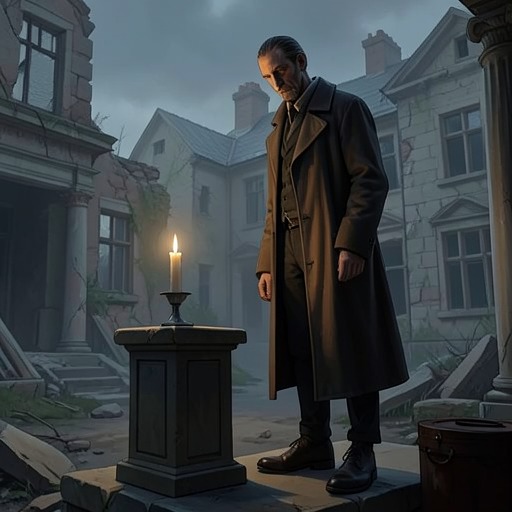
Wuthering HeightsEllen Dean, known to the Earnshaw and Linton families as Nelly, is the housekeeper of Thrushcross Grange and the novel's principal narrator, the steady, self-educated woman whose first-person account to Mr. Lockwood shapes the reader's entire understanding of Heathcliff, Catherine Earnshaw, and the two households. She is not merely a servant but the story's central consciousness, a lifelong witness to three generations of the Earnshaw and Linton families whose position at the heart of both houses allows her to observe and narrate the violent passions, degradations, and revenge that define the novel. Her telling, delivered in the evenings to the convalescent Mr. Lockwood, becomes the frame through which the entire history of Wuthering Heights and Thrushcross Grange reaches the reader, and her own judgments, sympathies, and silences color every event she recounts.
Identity and Background
Ellen Dean came to her position through a deep family connection to the Earnshaws: before she came to live at Thrushcross Grange, she was almost always at Wuthering Heights because her mother had nursed Mr. Hindley Earnshaw, Hareton's father, and she grew up playing with the children, running errands, helping to make hay, and hanging about the farm ready for anything that anybody would set her to. This childhood intimacy with the Earnshaw children placed her inside the household's emotional life from the start, making her a participant in the family's dramas rather than a detached observer. She describes herself as a steady, reasonable kind of body, a self-assessment she attributes not to living among the hills and seeing one set of faces and one series of actions from year's end to year's end, but to having undergone sharp discipline that taught her wisdom. She has read more than one might expect of a servant, having looked into nearly every book in the library at Thrushcross Grange and gotten something out of each, excepting only the ranges of Greek, Latin, and French volumes, which she knows one from another but cannot read; this is as much, she notes, as one can expect of a poor man's daughter. Her literacy and reflective habits set her apart from the ordinary run of servants, and Mr. Lockwood himself remarks that she has no marks of the manners he is habituated to consider peculiar to her class, and that she must have thought a great deal more than the generality of servants think, having been compelled to cultivate her reflective faculties for want of occasions for frittering her life away in silly trifles.
Life and Plot Trajectory
Ellen's life is bound to the fortunes of both houses from her earliest years. She was present when the old master, Mr. Earnshaw, set off on his journey to Liverpool, and she sat eating her porridge with Hindley and Cathy when he promised to bring each of them a gift, receiving for herself a pocketful of apples and pears from his kind heart. She witnessed the arrival of Heathcliff, the foundling who would become the novel's dark center, and she watched as the children grew up together, often crying to herself as she observed them growing more reckless daily, not daring to speak a syllable for fear of losing the small power she still retained over the unfriended creatures. When Catherine married Edgar Linton, Ellen was persuaded, much against her inclination, to leave Wuthering Heights and accompany her mistress to Thrushcross Grange, a parting made sad by her having just begun to teach little Hareton his letters; Catherine's tears proved more powerful than her refusals, and when she would not go, Catherine went lamenting to her husband and brother, with the former offering munificent wages and the latter ordering her to pack up, saying he wanted no women in the house now that there was no mistress. She told the master he got rid of all decent people only to run to ruin a little faster, kissed Hareton, said good-bye, and has since been a stranger to him, reflecting that it is very queer to think he has completely forgotten about Ellen Dean and that he was ever more than all the world to her and she to him. At Thrushcross Grange she served as housekeeper, retained by the master after the mistress died, and it is there that Mr. Lockwood, the new tenant, finds her eighteen years after she first came to the house when the mistress was married.
Key Actions and Objectives
Ellen's role as narrator is inseparable from her role as confidante, intermediary, and sometimes reluctant agent in the novel's central relationships. She is the recipient of Catherine Earnshaw's most intimate confessions, including the famous declaration that her love for Heathcliff resembles the eternal rocks beneath, a source of little visible delight but necessary, and the assertion that she is Heathcliff, that he is always, always in her mind not as a pleasure but as her own being. When Catherine makes this confession, Ellen jerks her gown forcibly away, out of patience with what she calls the girl's folly, and tells her that if she can make any sense of her nonsense it only goes to convince her that Catherine is ignorant of the duties she undertakes in marrying, or else a wicked, unprincipled girl, and she refuses to promise to keep her secrets. Ellen also carries letters and messages between the estranged lovers, at one point holding Heathcliff's letter to Catherine in her pocket for three days because she cannot guess how its receipt would affect her mistress, and she deliberately sends the manservant away on an errand for oranges so that she can deliver the letter in private. She is threatened by Heathcliff, who demands that she aid him in fulfilling his determination to see Catherine, swearing that he meditates no harm and only wishes to hear from herself how she is and why she has been ill; when she perceives his intention to depart, he interrupts her, telling her she is not going yet and that he must either persuade or compel her to aid him. She is also threatened by Edgar Linton, who tells her that the next time she brings a tale to him she shall quit his service, after she defends herself against his accusation that she encouraged him to harass his wife and gave him no hint of how she had been for three days, protesting that she performed the duty of a faithful servant in telling him and has got a faithful servant's wages.
Relationships and Conflict
Ellen's relationships with the novel's principal characters are marked by a combination of affection, moral judgment, and the inevitable distance of her servant's position. With Heathcliff she shares a complex history: she witnessed his degradation under Hindley's tyranny, when he was driven from the family's company to the servants, deprived of the instructions of the curate, and compelled to labour out of doors as hard as any other lad on the farm, and she observed that he bore his degradation pretty well at first because Cathy taught him what she learnt and worked or played with him in the fields. She is present at his most terrible moments, including his outburst at the news of Catherine's death, when he cries that she is a liar to the end and prays that she may not rest as long as he is living, and she watches him dash his head against a knotted trunk and howl not like a man but like a savage beast being goaded to death with knives and spears, observing several splashes of blood about the bark of the tree and his hand and forehead both stained. She is also present when he declares, of Isabella, that he has no pity, that the more the worms writhe, the more he yearns to crush out their entrails, and she asks him whether he understands what the word pity means and whether he ever felt a touch of it in his life. With Catherine she shares an intimacy born of years of care, but she does not hesitate to reprove her mistress's selfishness and folly, and she is often caught between her loyalty to Catherine and her duty to Edgar Linton. With Hareton she shares a tender bond from his infancy, when she began to teach him his letters, and she parts from him with a kiss and a sad farewell, reflecting years later that he has completely forgotten her.
Change and Ending
Ellen's narrative role extends to the novel's final revelations, as she becomes the recipient of Heathcliff's last confessions in his decline. He tells her of the strange change approaching, that he is in its shadow, that he takes so little interest in his daily life that he hardly remembers to eat and drink, and that the two who have left the room, Hareton and Catherine Linton, are the only objects which retain a distinct material appearance to him, and that appearance causes him pain amounting to agony. He describes how Hareton seemed a personification of his youth, not a human being, and how his startling likeness to Catherine connected him fearfully with her, and he confesses that the entire world is a dreadful collection of memoranda that she did exist and that he has lost her. Ellen listens to these confessions with a mixture of horror and reluctant compassion, noting that she did not like to hear him talk, and she maintains silence as he meditates on the picture of Catherine and wipes his forehead, his hair clinging to it wet with perspiration. She is also the witness to his account of being haunted by Catherine's presence, of opening and closing his eyes a hundred times a night to be always disappointed, and of being beguiled with the spectre of a hope through eighteen years. Her own narrative ends where it began, in the service of the household, having told the entire history to Mr. Lockwood over the course of several sittings, condensing her story as she goes and reflecting that she is, on the whole, a very fair narrator.
Narrative Role and Evaluation
Ellen Dean is the novel's narrative engine, the figure whose voice mediates every event and character for the reader. Mr. Lockwood, having heard all his neighbour's history at different sittings as the housekeeper could spare time from more important occupations, reflects that she is a very fair narrator and that he does not think he could improve her style, and he is interested in every character she has mentioned, more or less. Her storytelling is marked by a distinctive combination of moral earnestness and novelistic detail: she interrupts herself when she fears her tales cannot divert her listener, apologizing for chattering on at such a rate and noting that she could have told Heathcliff's history, all that he need hear, in half a dozen words, but she is persuaded to continue when Mr. Lockwood insists that she has done just right to tell the story leisurely and must finish it in the same style. Her narrative is not neutral; she is a participant in the events she describes, and her judgments of Catherine's folly, Heathcliff's cruelty, and Edgar's weakness shape the reader's response to them. Yet her account is also marked by a remarkable fidelity to the voices of others, as she reproduces at length the speeches of Catherine, Heathcliff, Isabella, and the rest, allowing their words to stand as evidence even when they contradict her own assessments. She is, in this sense, the novel's conscience and its memory, the steady, reasonable presence who survives the storms of passion and revenge to tell the tale, and whose own life, bound to the service of two families, becomes the thread that connects the novel's beginning to its end.